Showing posts with label Fantasy. Show all posts

Friday, October 12, 2018

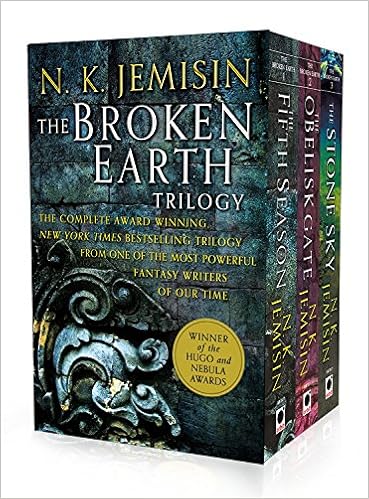
The Broken Earth Trilogy by N.K. Jemisin


This year N.K. Jemisin became the first person ever to win the Hugo Award for Best Novel three years in a row for her Broken Earth novels, and I cannot think of a more deserving series. This trilogy, which begins with 2015’s The Fifth Season, is a powerhouse of speculative fiction with amazing world-building and a storyline that is both intricately-plotted and immense in scope.

In The Fifth Season, readers are introduced to Essun, a woman on a mission to track down her ex-husband who has murdered their son and run off with their young daughter. Her plight is complicated by a “fifth season,” a major climate catastrophe that causes increased hardship and violence as cities crumble and ash fills the sky. Essun is an orogene, someone who can shape and control the earth, but has spent much of her life pretending to be normal, in hiding from those who would enslave or kill her because of her race. Now she will need to call upon her powers to protect herself on her difficult journey. Along the way, she comes into contact with a cast of characters who will help and hinder her along the way.

As Essun’s story progresses through the three books, readers come to know her painful back story as well as her present where she truly comes into her power, not just as an orogene, but as a mother and a person willing to fight for the future of the planet.

Jemisin is an amazingly powerful storyteller, adept at detailed world-building and a plot that weaves effortlessly through past, present, and future. Her characters are fully-realized, complex, and dealing with issues of identity, racism, oppression, and coming to terms with the fact that one person’s actions can truly destroy or save the world.  

This is a great series for fans of Octavia Butler, Margaret Atwood, Ursula K. Le Guin, or anyone looking for an immersive tale with unforgettable characters.


-Portia Kapraun

Sunday, February 04, 2018

The Outcasts of Time by Ian Mortimer


 It is December 1348, and Devon, England, has been over-run with the plague. Brothers William of Wray and John Beard were walking home to Moreton, trying to stay away from the pestilence by avoiding contact with anything that might carry the disease. Unfortunately, during their travels, William's act of compassion infects both himself and his brother. William insists that he needed to go to Scorhill because he heard a voice, just the day before, that told him in order to save his soul, he needed to go. His brother thought he went mad but knew he had no choice but to go. When the brothers stumbled into a stone circle they were given a choice; they could either go home and spend the last of their days with family, or become healed entirely and live their remaining days in the future. William knew that if he went home to his wife and children they too would get infected--if they hadn't already.  Both decide to take the journey into the future.


    There is a delicious twist to this tale. Each day takes them ninety-nine years into the future. These time-traveling brothers see the year 1447, 1546, 1645, 1744, and 1843. With each time lapse, they are losing traces of everything they once knew and dearly loved. The author, Ian Mortimer, has done a brilliant job depicting humanity at its worst and at its best. An exceptionally written book, I couldn't put it down and was very sad to say goodbye.

"My lady, I have lived many long years and I can tell you that fairness is to society as water is to a duck's back. Society does not change because of fairness: it changes because it sees an advantage."  ~William of Wray
~Dani Green

Wednesday, September 13, 2017

The Half-Drowned King by Linnea Hartsuyker


Norway is an astonishingly beautiful country.  Cascading waterfalls, vibrant flowers, birch trees intertwined with the deep tones of pine trees, and waters so clear you can see the fish swim past your legs. It was spectacular! When I went to visit an old Norske village I wondered what the people of Norway were like back in the day, these so-called "savage vikings" who pillaged and plundered wherever they went. I just had to pick up this historical read, The Half-Drowned King.

    Marriages for political gain, wars, battles, betrayal, assassinations, family disputes, and of course, scandalous relationships were all a  part of any royal family, in this case the "royal clans".  When Ragnvald Eystein, the son of a chief, was betrayed and left to die by whom he thought was his close shipmate, Solvi, revenge overcame him. To regain his lands, fortune, and his betrothed, Ragnvald pledged his allegiance to Hakon who was a neighboring Lord, but there is a twist to all this delicious madness.  
 This book is a must read.  A deliciously written masterpiece!

~Dani

"Anger is a pilot who always steers his ship onto rocks. It is a poor guide."
Lord Hakon

Friday, July 21, 2017

The Bedlam Stacks by Natasha Pulley

It’s 1859 and world-traveling botanical expert Merrick Tremayne believes his days of adventure are over after a leg injury. He has resigned himself to a life of solitude on his family’s deteriorating Cornwall estate with no company but his unhappy brother. When an old friend shows up to convince him to set off for Peru in search of cinchona tree cuttings for the East India Company, Merrick is initially resistant. With much needling from his friend and his brother threatening sending him to an asylum, Merrick relents and joins the expedition. Peru has a monopoly on the cinchona trees, the only source of quinine, and has begun charging exorbitant prices for the anti-malaria drug. The East India Company believes the Tremayne family’s ties to a remote village will allow him to sneak into the forest and smuggle out the cuttings under the guise of searching for frost-resistant coffee plants. Upon arriving in the village, Merrick discovers that the Peruvian mountains hide more than just the cure for malaria. There are exploding trees, a border of salt that is said to be fatal if crossed, moving statues, and a priest with a strange illness. When the quinine runners catch on to Merrick’s plan, he and the priest cross the salt border and enter the unknown forest hoping to make it out the other side alive.

This is Pulley’s second book, and has some loose ties to her debut, The Watchmaker of Filigree Street, though each can be read as a stand-alone novel. A gifted storyteller, Pulley manages to make the fantastic aspects of her stories seem just as plausible as the mundane and shows the reader that true magic is found in love, trust, and enduring friendship. The Bedlam Stacks will be released in August 2017, but you can put your name on the holds list today!

- Reviewed by Portia

Thursday, March 09, 2017

Norse Mythology by Neil Gaiman

I discovered Neil Gaiman rather recently, but am no less an ardent fan for this delay.  To quote a fellow librarian, “if [Gaiman] published a phone book, I would read it,” and Norse Mythology is a far cry from such a dry litany. My prior knowledge of Norse lore was scant and unformed. In my mind, the birthplace of Scandinavian legend was one where chiseled Marvel heroes and goofy Cressida Cowell creations frolicked through a wintry and forbidding landscape. So, the terrain covered in this book was a fairly novel one for me, and I was eager to give Gaiman’s take on it a look.  I was not disappointed.  As in all of his works, the characters, however fantastical, are made real.  A reader is able to look into the eyes of even the most uncommon of giants, and see him or herself reflected back. 

The book is structured as a series of mostly chronological stories involving the Norse Gods, leading up to Rangnarok, i.e. the Nordic apocalypse. Some of these characters I had met before in some form (Thor, Odin, Loki), while others were new to me (Hel, Balder, Frey, Freya). Several of the tales have the feel of a creation myth about them: the origin of fall feasting, the source of poetic inspiration, and the gates of Hell; others are wry re-tellings of the various exploits of the Gods. Gaiman brings these ancient heroes to life with his characteristic insight and wit. His passion for the Norse tales of old becomes your own by the novel’s end.  I would highly recommend this novel to lovers of myth and fantasy.

-Jennifer Wilson

Friday, December 23, 2016

The Invisible Library by Genevieve Cogman


I will admit that I knew nothing about this book but the title when I picked it up. I assume that I will love any book about books and libraries, and I am rarely disappointed. That being said, The Invisible Library was an especially fun ride for me because the librarians were not just book lovers, but undercover book stealing spies!

Irene works for The Library, a repository that exists outside of time and space where Librarians work to collect and store all works of fiction written in the many alternate worlds of the multiverse. Irene and her new assistant, Kai, are sent to a world to retrieve an original manuscript written by the brothers Grimm. Unfortunately for them, this particular world has become infected by “chaos” making it that much more dangerous and unpredictable. Add in a rogue colleague, a nefarious fairy, giant mechanical insects, and a master villain intent on destroying the Library, and you’ve got an action packed adventure like none other. Fans of Jasper Fforde’s Thursday Next series will enjoy the quick banter, peculiar worlds and entertaining plots, though The Invisible Library underlines its quirkiness with a sense of foreboding.

It’s hard to believe that this is Cogman’s first novel. The characters are well-rounded, the settings written with such detail that I felt like I was there, and the plot was engaging and suspenseful. What’s not surprising is that this book made a number of “Best of” lists for 2016.

-Portia Kapraun

Wednesday, March 23, 2016

All the Birds in the Sky

I have a confession to make. I first looked at this book because of its beautiful cover. And I like birds. A lot. But then I read the blurb by Michael Chabon on the front cover, and all the positive reviews, and I was hooked. This book is a bit strange, but oh so compelling. It's about the end of the world, the balance between magic and science, and two childhood friends, Patricia and Laurence, who grow up on either side of that balance. Patricia is a graduate of a secret magic academy (think Hogwarts) and works with a small group of other magicians to secretly fix problems that occur in the world. Laurence is an engineering genius working with a group of techies to try to avoid global catastrophe through technological means. It's very difficult to give a quick summary of this book, because it defies categorization, and I don't want to give away too much. If you like coming of age stories, fantasy or science fiction, or dystopian future stories, give this a try. Patrice and Laurence are smart and lovable and quirky and will steal your heart, despite the wild and crazy storyline, I promise.

submitted by Kelly Currie

Wednesday, January 20, 2016

Anansi Boys by Neil Gaiman

Since discovering author Neil Gaiman last summer, I’ve been meting out his novels to myself like a harried mother with a limited supply of Halloween candy.  So, after surviving 2015 relatively intact, I rewarded myself with his 2006 novel, Anansi Boys. The novel proved to be a treat worth savoring as it exemplifies the very things that make a Gaiman novel worth letting your clothes lie wrinkling in the dryer: characters that are funny, endearing, and immanently human; a story that is fantastical and engrossing; and a narrative voice that is confiding and not a tiny bit cheeky.

Anansi Boys builds upon themes that readers of his earlier novel, American Gods, will find familiar; however, it can stand alone perfectly well.  The story opens in England, with “everyman” Charlie Nancy.  He’s your average work-a-day fella, the archetypical accountant: shy, quiet, unassuming, and unremarkable in any way.  When pressured by his do-gooder fiancĂ© to attempt to contact his long-estranged father to invite him to their impending nuptials (Charlie’s reluctance to do so stems from what he perceives as a childhood of perpetual and near-fatal embarrassment at the hands of, via proximity to, and on behalf of said father).  Upon phoning a childhood neighbor in Florida, Charlie is surprised to find that his father has quite suddenly died. He crosses the Atlantic to just miss the funeral, and learns two things that beggar belief.  The kindly old neighbor, Mrs. Callyanne Higgler, informs him, matter-of-factly, that his father was the God/Legend Anansi, and that he has a brother, who inherited all the father-to-son god-like traits.  When asked how he might reach this heretofore unknown brother, Mrs. Higgler casually mentions that he need only to speak to a spider on the matter.  One long transatlantic flight and several glasses of wine later, Charlie, on a bit of a lark, does just that.  What follows from there is a wildly entertaining journey that crosses continents and worlds.

Lovers of fantasy and/or plain old clever writing need look no further, Neil Gaiman has it covered.

Posted by Jennifer Wilson